Draft 34 — 1 Sep 2026
The retelling, kid-tested and revised: the white-barked boy is trackable from slide one, the grove attack becomes net-carrying catchers that know exactly which Woodie they want, and the chase earns Willow's entrance.
Series One · Eight Issues
Arden woke alone to a field of stumps, and everyone he loved carried away from Wondermist and scattered across eight regions of the world. He has a plan to bring them home. The plan is the thing that has to break.
Thematic spine
What is alive cannot be taken — only joined.
The Logger cut through every one of them. Series One visits each once, and each has a different kind of search — so the journey never reads as eight identical retrievals.
Issue 1
Green grown over the trail. Waterfalls, forest roads, and the first collision with the Logger's crew.
Issue 2
High water, cold and fast. Willow's maps, caches and safe routes lead Arden to a friend who has changed.
Issue 3
Slow water, and a spirit in it. The first proof that Merkle is one voice among many — and a negotiation, not a rescue.
Issue 4
Dry plains under a low sun. Rosie has built a life here, and asks the question that breaks the quest.
Issue 5
Peat bogs, and Yanu's masks. The strangest chapter in the saga, and the one that explains Arden to himself.
Issue 6
Desert wind, carrying a voice — until it doesn't. Merkle goes silent and Arden has to act anyway.
Issue 7
Snow, and quiet under it. Oak Arrow's resistance operates among frozen Logger roads.
Issue 8
Where Arden woke to stumps. The search ends where it began, at a trap everyone knows is a trap.
Wants, needs, lies and ghosts live behind the gate. Designs by Spudnik Art.
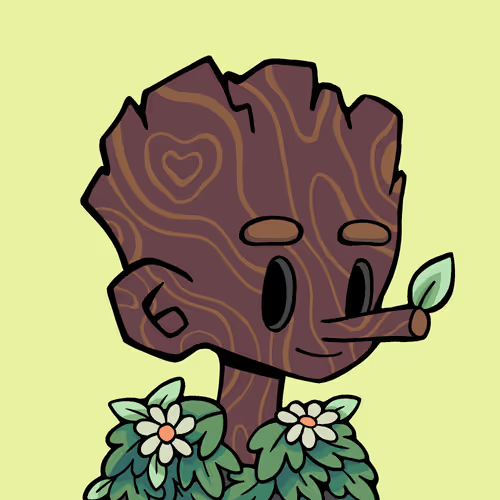
Four feet tall, leaf on his nose. Wants everyone home; needs to stop trying to put things back.
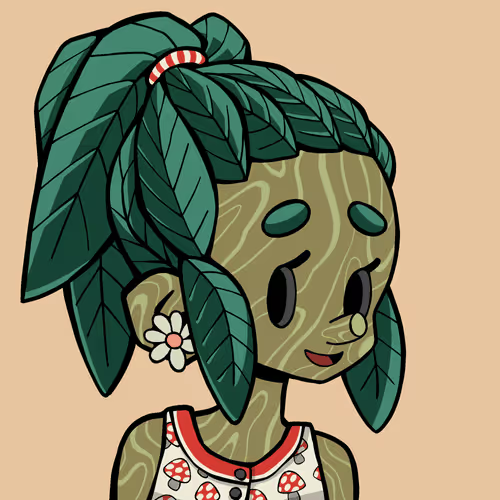
Escaped the truck alone, then went the wrong way. Has been building plans ever since.

Found a home worth staying for, and asks whether that counts as betrayal.
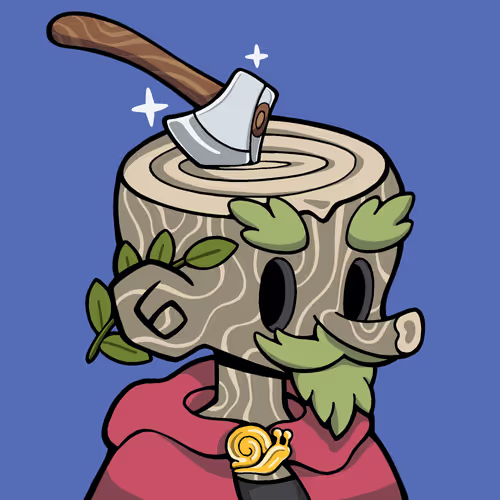
The danger passed and he never stood down. The story's strongest dissenting voice.
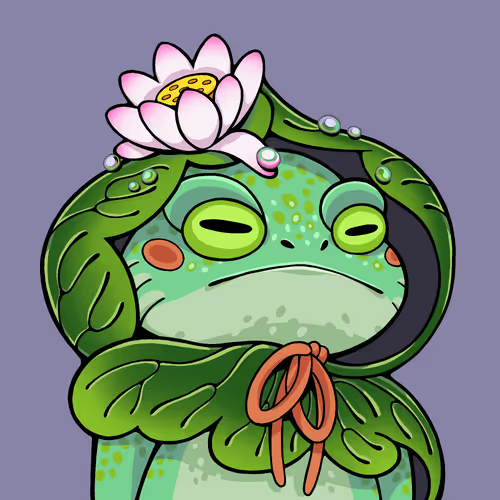
An ecological sixth sense she cannot explain and is usually right about.
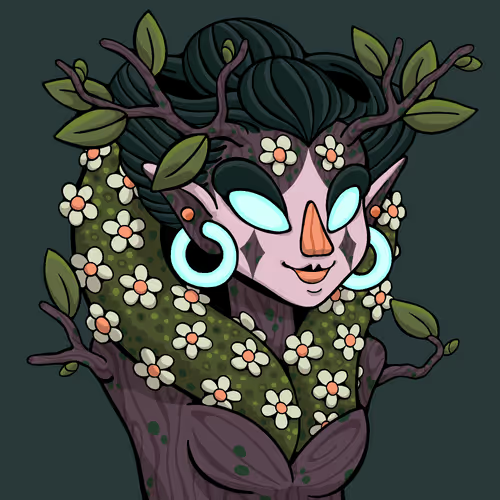
Saved the Woodies, not the forest. Her voice fades wherever the damage is worst.
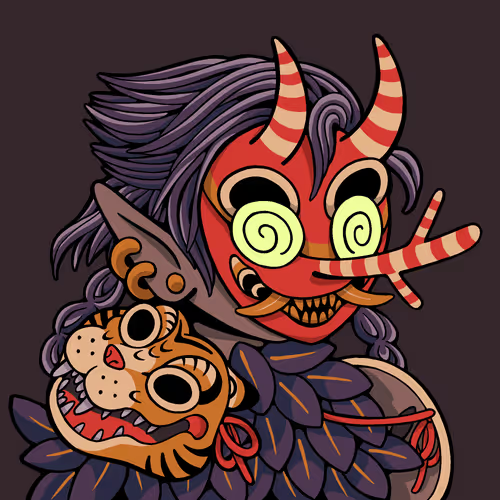
The mask maker of Muckshire. Every mask has a side effect he finds funny.
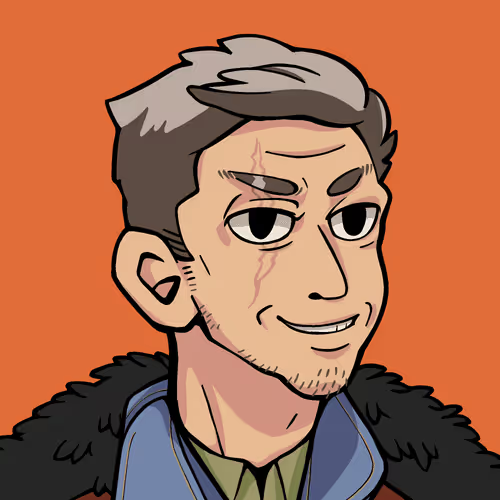
A system before he is a face. Believes anything valuable can be owned.
Slide polish: the tag-shot shown but never explained, nets that take Woodies in the first seconds, a hint of green where the power will someday be — and the deck now ends on the last line itself.
The retelling, kid-tested and revised: the white-barked boy is trackable from slide one, the grove attack becomes net-carrying catchers that know exactly which Woodie they want, and the chase earns Willow's entrance.
The bible gained a full-screen retelling of Chapter One — sixteen slides that tell the issue the way a reader will live it, launched from a single button in the exhibit.
Issue #1 pruned to its bones and shipped: a dead Wondermist, an interrupted reveal, two drones, a furious rescue, and a last line with no warmth in it. ~22 pages, nothing extra.
Leaned the Issue #1 exhibit down to a status line and the beats. The story speaks for itself now.
Leaned the Issue #1 exhibit's preamble to two paragraphs — the beats carry the rest.
Arden wakes into rain and meets a stranger in a puddle — he has never seen his own face, which quietly proves why nobody in this story recognizes anybody. And the first issue's last line is ruled: "What are you staring at?"
The final page's asymmetry made airtight: he runs at every walking willow because he's searching; she can't recognize him because in the legend she tells, he is the tree that was left standing. The five years become five thick rings of the wrong kind, read from his own arm — and the village knows his story from her legend before he knows it himself.
Issue #1 found its ending: the legend herself arrives in the climax — precise where the hero is wild — saves the village with a drill she came back to test, reads the villain's counter-move off a pried tag, and closes the issue looking at a stranger's face: "Do I know you?" They were trees together. Neither has ever seen the other's face.
Issue #1 fully restructured: it now opens at Arden's first waking, with no humans in the issue at all. A village kid's mischief starts the story, a log truck carries a newborn out of a graveyard, a grove gives him the word for what he is — and a legend's name gives him a direction.
The inciting image re-sourced: no hiker, no thread — it's the company's own restoration brochure on the camp's know-your-enemy wall. The villain printed the lie, and the lie had her lean in it.
Issue #1's engine ruled: the search, not the dream. The sleep is taking his friends' faces — his drawing can hold everyone's place but not Willow's face — and the followed clue is a willow that should not be there, in a photograph. The wrong clue proves a true compass.
The stolen years ruled: Arden was unconscious through the five-year gap — a node going dark when the grid failed — and woke believing the cutting was yesterday. His grief is day-one fresh in a world that is five years on, and the dream-gift becomes the sleep's scar.
The inciting clue defined: a hiker's photograph of "miracle regrowth" on the Search network's thread — and the regrowth's author is the villain, his replanting program photographed as healing. The finale's greenwash now pre-figured in issue one's first clue.
The finale reframed as a power play: the hero was never the prize — the living system is, harvested toward energy technology, extraction rebranded as clean. The villain loses by disproof, not combat, and the next series inherits his pilot plant.
The origin becomes an experiment: the villain cut the tree, left it in the ground under a camera, and later claimed the trunk with the boy-shaped absence in it. Arden is proof — on film — and the finale's reveal can be a screening. An easter egg is planted in issue #1's opening pages.
Three rulings: transformation leaves the log behind with a person-shaped absence (and the operation's photo file of those voids), Willow trains escapes in person while running ahead of the villain's schedule, and the opening dream loses its GPS — the direction to Verdantu is a found clue whose meaning turns out to be wrong.
Issue #1's connective tissue settled: the dream is a relayed distress call, the Willow lead triangulates to the Himmelriver corridor by map-logic, and the companion question is ruled — none. The van starts with one Woodie in it and fills across the series; the first person Arden saves is the first to say no.
Merkle removed from Issue #1: her silence becomes the series' quietest mystery, and saving her the reason everyone finally comes home. The humans supply the direction, a grove pays for the revival, and the first Woodie companion is proposed.
Issue #1 restructured: the cold open cuts unresolved on terrified eyes, and Arden wakes from the dream in present-day Wondermist — the series now opens and closes on the same ground. The bible page gained subheading navigation in the left rail.
The cold open became a dream that is not one — Arden wakes from a stranger's chase to stumps rolling past the van window — and the origin gained its final mechanism: nobody caught him when the cut came; the relationship did. The only Woodie grown rather than made, and a reveal ladder with four rungs.
Issue #1 re-beaten for the long account: the cold open braided so Arden's gift and flaw open the issue before his face does, the child register carried by a drawn map of a Wondermist that no longer exists, and a triple-hook ending — the standing order, the first harvest, and the gray root.
Arden's origin revised to "the long account" — the cut delayed by years, the time lapse turned into the wound — and a seven-item departures ledger added against the eight-issue source document, including the villain's missing economy: blooms leave harvestable threads, and the crews arrive behind the heroes.
Arden's origin settled in recommendation form as "the closed account": the Logger killed his own prize by clear-cutting the relationships around it, then cut the worthless heart tree on the last night. No time jump; the reveal becomes a three-rung ladder, and the eight-region trail exists because he ruined his own deposit.
Filed decision 10, the world under the world: awake groves in every region with their own guardians, the cut-only rule, Arden's two-stage reveal, and the fungus defined as the Root's living interface — including why the Logger's survey rig works at all. Open decisions 9 → 10.
Removed the "Mother Merkle" honorific proposal — ruled out. She is Merkle, Guardian of Wondermist.
The hero–villain symmetry written into the thesis: a rescue and a harvest are both fetch operations, and only one of the two thinks he owns what he's fetching. The proposed cast (Fen, Boone, Pell) joins the People section under a new minor-cast template, all draft-tagged; the Logger gets a proposed ghost and a flagged canon ambiguity; "Mother Merkle" is noted and proposed as an honorific.
Rewrote the cover gloss to carry the pressure system's thinking: the regions as characters with their own wounds, the chase named as a cultivation, and hero and villain now making the same mistake — one lovingly, one at scale. Draft-proposal clauses stay tagged.
The Willow lead gets its mechanism: an underground railroad along the Logger's own routes, met through her works two issues before her face — and its dark mirror, the tag-and-follow protocol. Plus a marking pass: everything unapproved is now visibly tagged as draft, so canonical work stays clearly separable.
Rebuilt Issue #1's cold open in the pressure-system proposal: an escapee, a plantation hunted in rows, and a drone whose mercy is a hidden tag — the series' mystery performed wordlessly before the title card. The tag's discovery becomes a betrayal with no villain in it, and teaches the mark format that Issue #4 pays off.
Added the pressure system — a six-part unapproved proposal for Chris: the villain in motion, the chase-as-cultivation twist, an on-page falling in Issue #1 with two failure modes for Arden's power, a wrongness and mechanic for every region, recurring crew faces and machines, and the next series' threat seeded without a name. Ships with a canon-vs-proposal table and a full retelling of Issue #1 as the exhibit. The NeverEnding Story joins the comps. Open decisions move from 8 to 9.
Added the comps to the argument: Finding Nemo, Princess Mononoke and The Iron Giant, fused into one combination — you can be kept as a thing, and still choose to be a person — with The Wizard of Oz logged as the anti-comp. Recorded a recommendation on the last foundational contradiction (how Arden is a Woodie) for Chris to rule on.
Consumed Chris's Universe & Story Bible v2.0. Eleven of sixteen open decisions closed by canon — what a Woodie is, what an axe does, the Root's two layers, the audience, the cost of the power. Open calls drop from 16 to 8. Character designs added throughout.
Rebuilt the bible as a reading deck rather than a typeset document: the spine now opens it, and the argument is carried by a thesis diagram, an eight-issue rail, cast cards and before/after cards. Added a light/dark toggle. Promoted six world-rule gaps into numbered decisions — the count moves from 9 to 16 because the holes are counted now, not because new ones appeared.
First revision layer over Chris's canon document. Promoted extraction-vs-relationship to the thematic spine. Added want/need/lie/ghost interiors for eight characters. Named three structural problems and logged nine open decisions. Canon ruled to be Chris's text document over the public brand site.
Eight-issue arc, revised canon edition. Regions, power ladder, Logger mystery and breadcrumb ledger established.